🦸 Finding Productivity Superpowers 🦸

🥺 Disclaimer 🥺 this is a long one again. I’m sorry, I just couldn’t stop writing. Probably set aside 5-10 minutes if you want to read this one.
Dear friends,
Toward the end of last week, I started feeling pretty overwhelmed with everything I was working on. As you may recall, I had several software projects brewing: one for work, one for fun, and two actual startups.
You may have asked yourself, “How does Wilson manage all those projects? He must be really productive.”
I have to confess, now, that I am a liar. But before you get all uppity about how lying in this publication goes against its entire ethos, I’ll add that I was also lying to myself.
In tech, it looks like everyone is doing a bunch of cool things at once. My Twitter feed is polluted with announcements of products, services, moves, funding, hiring, and more. Elon Musk runs three or four corporations at the same time. It’s easy to feel like not announcing something each week makes you a failure or inadequate in some way.
Journalists and social media have this way of distorting how we see reality. The people with whom we connect online don’t appear animate – they are just avatars spewing out their next crazy thought, in under 280 characters, without context (Hey, I didn’t design it, I’m just telling you how I feel). In 2020, we have more data than ever, but to make it digestible, we have to compress it; and when we compress it, we lose important information.
I’ll use a technical allegory to illustrate this point. The human eye is capable of immense detail – the idea of “pixels” almost doesn’t exist down at the nerve level. A 2006 study found that the human eye can transmit 10MB of information per second. For context, one photo on my “prosumer” DSLR is 20MB of raw data. People specifically buy these types of cameras to capture high-resolution, high-color depth images, so photographers don’t mind these large file sizes in favor of an image that is easy to edit.
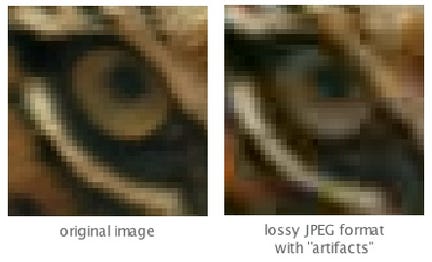
When we’re consuming images, we approach from a different angle. The space on your hard drive is limited. If every photo you took was 20MB, you’d run out of space within just a few weeks. To get around this, computer scientists have come up with some clever algorithms to strip out information and make a “close-enough” version that appears about the same. But if you zoom in, you see an image like the one above: some things seem off because you’re trying to make the same image with quantifiably less information, so some of the details just won’t be right.
Minimizing Compression
Our minds similarly compress information. In fact, the more you recall a memory, the less true it becomes. Your brain manually rewrites the memory every time you remember it. So, if you’re still in school, this is an excellent excuse as to why you may have performed poorly on your last exam.
Running four software projects at once will force you to compress a lot of information. It will force you to think in silos, instead of holistically. And worst of all, most minds, including mine, are not capable of solving four massive problems at once. There’s no possible way for me to simultaneously consider the needs of WordPress shop owners and developers; people with bad Twitter accounts; people who want to automate their trading strategies; and salespeople who want to be best prepared for their meetings. It’s just too much. If you’re following along, and you’re not anxious yet, please reach out to me so I can hire you as my replacement.
To minimize the compression in our daily lives, we have to decrease the flow of information into the system. The amount of information our minds can manage at once is small. The amount of information we can take in is nearly infinite. If we can’t match the “information in” to the “information stored”, we get a nervous breakdown. And, the way I see it, knowing a little less about what is going in the world outside is preferred to mental and emotional collapse.
Low-information Diet
Silicon Valley Thinkboi Techbros like throwing around the term “low-information diet” to describe their practice of not reading the news, or playing games, or reading books, or doing things outside their companies.
For my purposes, a “low-information diet” means more focus. Others have written with more quantity and quality than I could about how damn easy it is to get distracted these days, but the most successful (average) people have learned to focus. And I’m not talking about “productivity hacks” like Pomodoro timers and fidget cubes.
No, I am talking about “life focus”. We walk around this Earth, wondering what the purpose of our life is. In reality, we determine this for ourselves — it’s all under our control. It’s a matter of first determining your principles; then setting goals that align with those principles and finally, not doing anything that does not align with those principles.
We all have visions of how our lives will be. We have ideas of the kinds of people we want to be, the kinds of people we want to be around, the kind of work we want to do, the kinds of problems we want to solve, the kind of marriage we want to have, the kind of financial situation we want… we all have hopes and dreams, and it’s really hard to chase them when we’re distracted.
If we are not dead-focused on building the lives we want, things get rough. We might settle for a mediocre lifestyle, or mediocre friends, or a mediocre job, a mediocre partner, or a mediocre salary. Or, in some cases, all of the above.
Many people acknowledge that they are not living the life they want, but have no idea how to get out. The secret? Have a plan, and focus on it. Your plan doesn’t have to be the same in five or ten years. We are dynamic. But you can’t live life under the assumption that your circumstances will change constantly, or else you will never live life in the first place.
Eleven words to decide what to do
I don’t identify as religious, but I think every religion is based on stories that give us strong guiding principles for life. So, I will paraphrase the parables and turn to the book of Nehemiah from the Old Testament, where the titular character is rebuilding Jerusalem. Andy Stanley gave a sermon a few years ago that inspired the philosophy that follows.
The Jews had a lot of people trying to stop them from rebuilding Jerusalem. Nehemiah insisted that the project continues at all costs to expeditiously and successfully rebuild the city for God and His people.
One day, Nehemiah is reconstructing the walls of Jerusalem when a messenger comes to him and says, “the King would like to see you urgently.” In those days, if you are summoned by the King, you drop everything and go to him. But Nehemiah says, “I am making a great work, and I can not come down. Why should the work stop while I leave it and go down to you?” So he continues to build, and the messengers leave.
Now, most people reading this aren’t rebuilding the walls of a destroyed ancient city. But we do all have a “great work,” and the best part is we get to define it for ourselves. Once I started looking at things through the lens of building the great work of my life, it became a lot easier to filter out the noise and focus on just the things that will move me toward building my city.
If your friends, family, partner, or other people in your life don’t make you feel the way you want the people in your life to make you feel, then do something about it. Next time that person texts you: “I am making a great work, and I can not pull thru.”
If you are saving for a house, car, or a real investment, and you get invited to Vegas, or to sell Cutco knives, or go out to the bar: “I am making a great work, and I can not come down.”
I’m not telling you what you should want out of life. I’m not telling you that you should deny pleasure, either. We are all just apes with cell phones and a near-infinite supply of food; beyond that, you can do whatever you want. You can become a leader loved by millions of people, or live alone in the wilderness, with mere dozens of people knowing about you, and be happy either way. Just define your great work, and make decisions against that framework.
Ok, so WAYWO 👷
Oh boy, you made it. Well, lucky you, because now you get to see this awesome new startup my good friend, my new friend, and I are starting. It’s called Quinn. I can not tell you anything about it, because we are being stealthy, and Google will definitely find this after like 300 microseconds of looking around. So, I have prepared a spiel to give you on request. It includes a beautiful memorandum document to fill you in. Just shoot me a reply and I will gladly send it all over.
I wish you and your families all the happiest of holidays! Stay safe and healthy, and I’ll see you next week.
wh